Rubin doubles the known trailing Neptune Trojans, from two to four
A team led from Queen's University Belfast used early Rubin Observatory data to confirm two new stable Neptune Trojans in the planet's trailing cloud, doubling the known number.

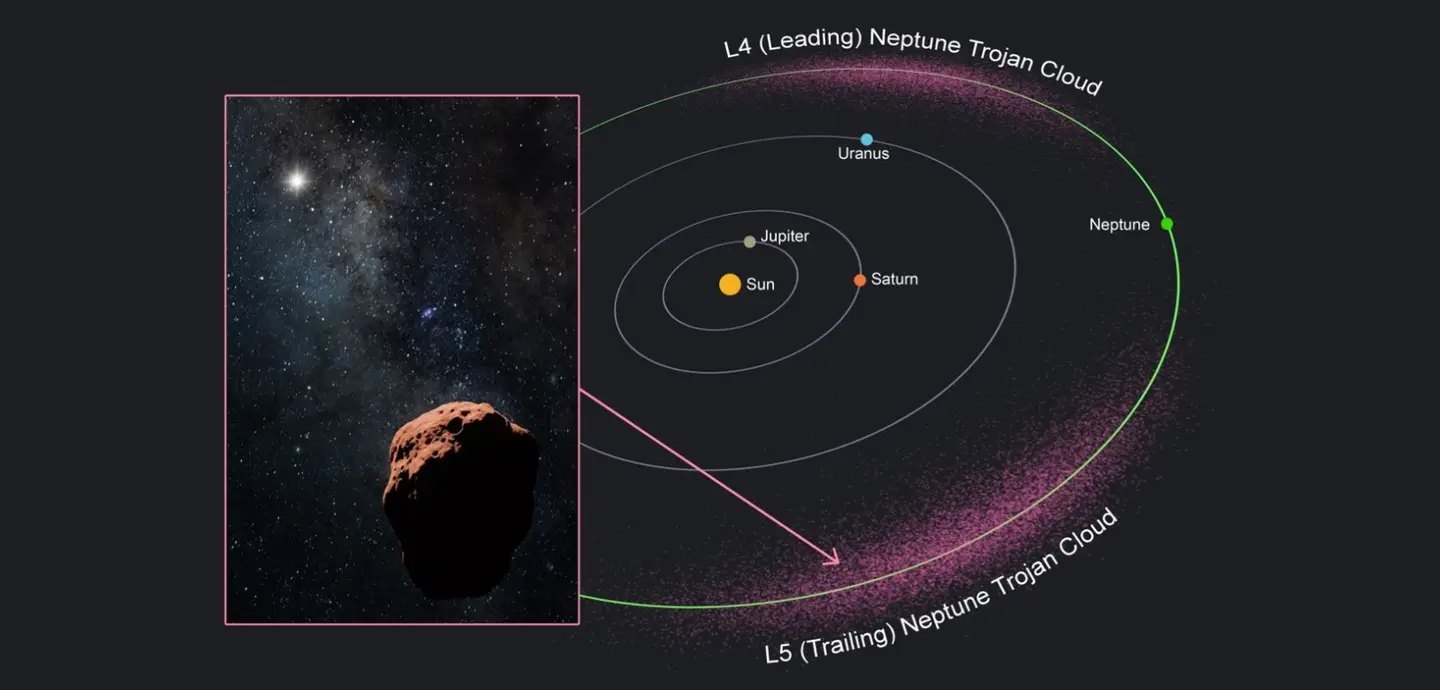
Astronomers led by Dr Meg Schwamb at Queen’s University Belfast have used early Vera C. Rubin Observatory data to confirm two new long-term stable Neptune Trojans trailing the planet. That doubles the known sample of the trailing cloud, according to the university’s announcement and the team’s paper.
Small bodies riding along with Neptune
Neptune Trojans are small icy bodies that share the planet’s orbit. They are held in a 1:1 resonance, meaning they circle the Sun in the same time as Neptune, in two clouds centered on points about 60 degrees ahead of the planet (called L4, the leading cloud) and 60 degrees behind it (L5, the trailing cloud). Objects with orbits that remain stable for billions of years are called primordial, because they are thought to be original members of the population rather than recent captures.

The trailing cloud has been hard to study. For more than 15 years it sat near the Galactic plane and center, where dense star fields make it difficult to pick out faint moving objects. By 2025 it had drifted far enough from the plane to fall inside the footprint of Rubin’s Science Validation survey, run during the observatory’s commissioning period, according to the paper, which was submitted to arXiv on 28 October 2026 and published in The Astrophysical Journal Letters.
2025 MH348 and 2025 NN80 pass the billion-year test
The two confirmed objects are 2025 MH348 and 2025 NN80, first detected on June 21 and July 7, 2025. The team also reports a third, 2025 MD138, as a candidate. Its observations span only 38 days, too short to settle its orbit. In computer simulations of 100 variations of its orbit, 23 stayed in the resonance for a billion years.

The two confirmed objects stayed in Neptune’s resonance in billion-year simulations. The paper reports that 2025 MH348 swings back and forth around its resonance point with an amplitude of about 33 degrees, and 2025 NN80 with about 23 degrees. Only one of them, 2025 NN80, had its brightness fitted well enough to give an absolute magnitude (a measure of intrinsic brightness) of about 7.7 in the r filter. The paper gives no diameters.
Rubin imaged the objects through several color filters, which shows how reddish or bluish their surfaces are. The authors describe the colors as bluer than two previously measured trailing-cloud objects and consistent with the leading cloud, so the two clouds appear to have similar surfaces. The paper also presents the first characterization of objects found by Rubin’s moving-object pipelines using observations spaced like those of its full survey.
A survey built to outpace the old searches
The comparison with earlier searches is stark. Before this work only two stable trailing Trojans were known, 2008 LC18 and 2011 HM102, set against more than thirty known Neptune Trojans overall, most of them in the leading cloud. Rubin got two more from a single early survey, in a part of the sky that older searches struggled with.
A separate forecast by Joseph Murtagh and colleagues, published in The Astronomical Journal, puts numbers on what is coming. Using a survey simulator, they predict Rubin’s 10-year Legacy Survey of Space and Time will find roughly 130 to 300 Neptune Trojans, depending on the model, four to nine times the 31 listed by the Minor Planet Center (27 leading, 4 trailing). They expect detections to favor the trailing cloud by about 2 to 1, and about 60 percent of detections to have light curves good enough for color measurements, which would more than quadruple the existing color sample. The caveat they raise: crowded star fields near the Galactic plane could cut the trailing-cloud yield.
The Queen’s team said Rubin will keep observing fields that overlap the trailing cloud, which should show whether the similarity between the two clouds holds up as the sample grows.