A decade at Mars: Europe’s gas-sniffing orbiter has found no methane, and plenty more
Ten years after reaching Mars, ESA's Trace Gas Orbiter has mapped over 10% of the surface, found no methane and become a dependable relay and operations workhorse.

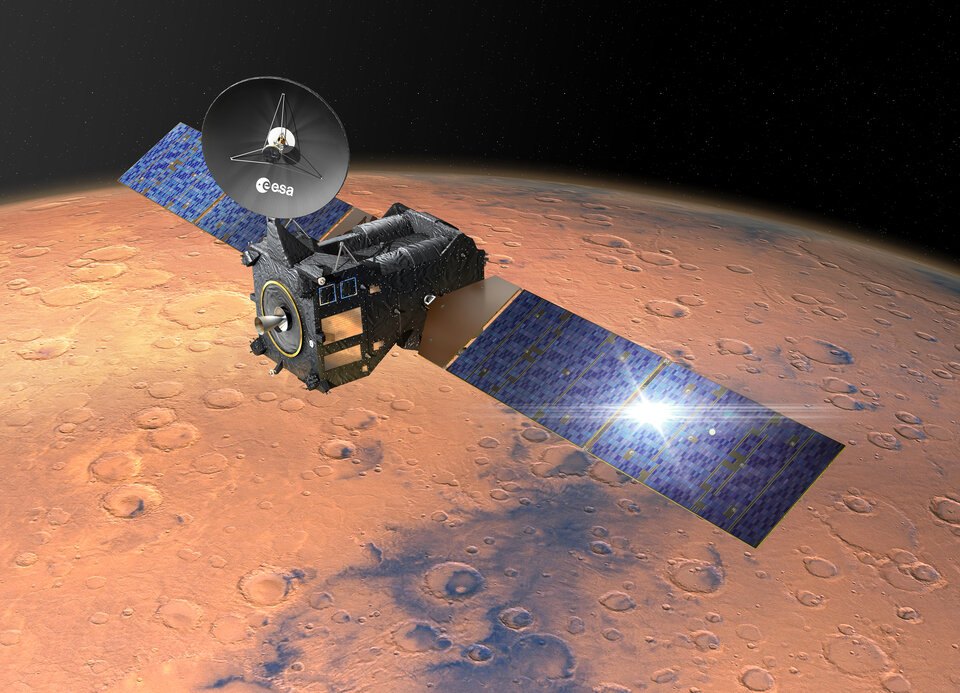
ESA’s ExoMars Trace Gas Orbiter (TGO) reached Mars on 19 October 2016, and ESA marks the tenth anniversary with a gathering of past and present team members at its operations centre in Darmstadt, Germany. The orbiter has so far found no methane in the martian atmosphere.
Arrival day: One success, one loss
TGO fired its engine to slow down so that Mars’s gravity could capture it. ESA’s account puts the burn at 13:05 UTC, with arrival at 15:24 UTC, and says controllers confirmed capture after the spacecraft re-emerged from behind the planet and its signal returned. On the same day the Schiaparelli lander, a small demonstrator built to test landing technology, entered the atmosphere. A software-related problem switched its descent engines off too early and the module was lost. ESA says the data it sent back gave lessons that have since been applied to the Rosalind Franklin rover mission.

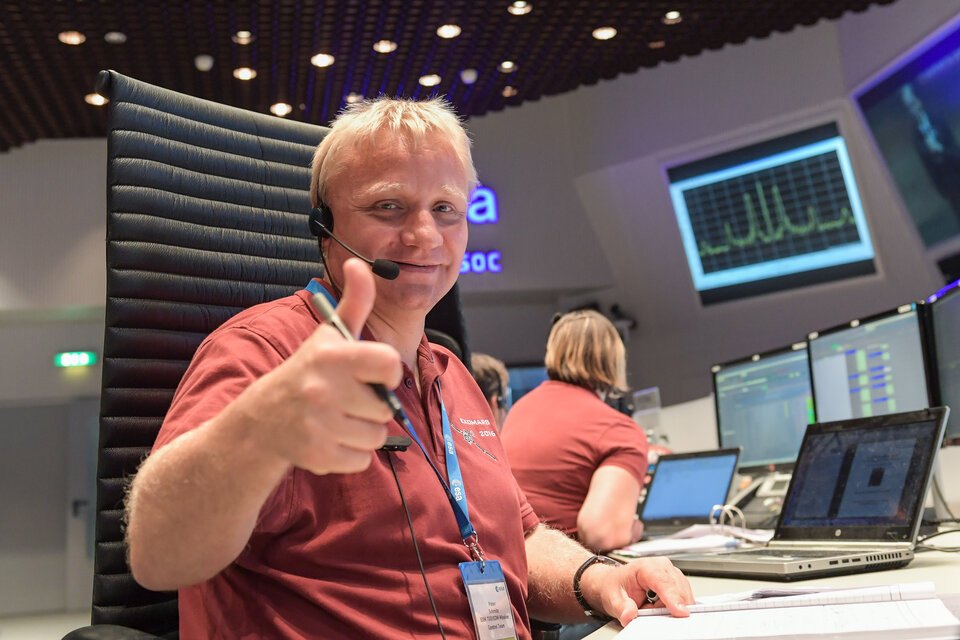
Silvia Sangiorgi, head of ESA’s Mars exploration missions operations unit, recalls feeling “much lighter” afterwards, but there was no pause: almost a year of aerobraking followed. That is a technique in which a spacecraft dips into the upper atmosphere again and again, using the drag to shrink its orbit without burning much fuel.
What a gas detector found, and did not find
Trace gases are the faint ingredients of an atmosphere, present in tiny amounts. TGO flies about 400 km above Mars to measure them, and project scientist Colin Wilson says it was designed to be “more sensitive to trace gases than any other mission, probably in a generation.” That matters for methane, because on Earth much of it comes from living things, so earlier reports of it at Mars raised hopes of a sign of life. TGO has not detected any, a mismatch ESA says continues to drive research.

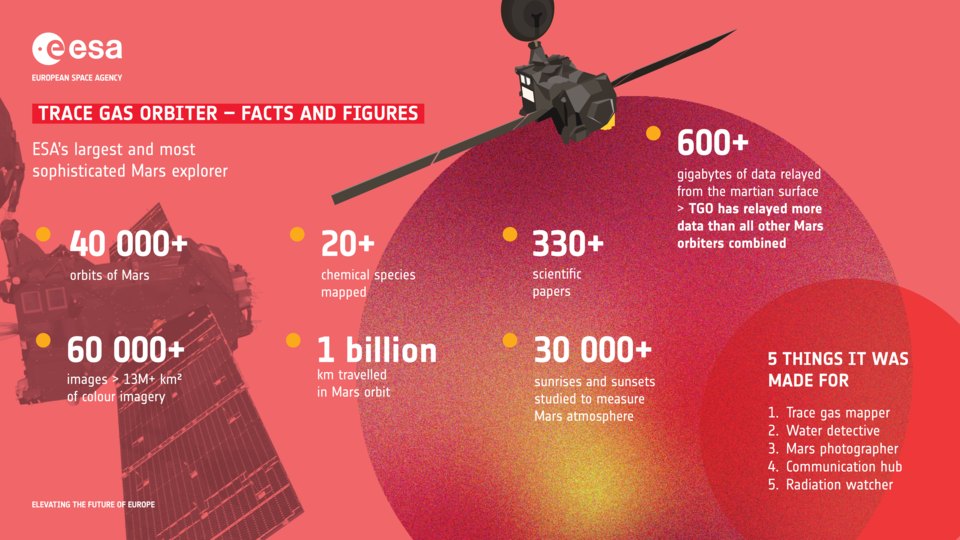
The orbiter did make the first detection of hydrogen chloride in the martian atmosphere, which ESA says gives insight into atmospheric processes and possible geological activity. It has also measured water loss, mapped subsurface water ice and monitored radiation, data that matter for future human exploration. Its camera has imaged more than 10% of the surface in four colors, and that work has supported landing-site studies for Rosalind Franklin. Anyone following the wider Mars fleet can see how it fits alongside the Mars rovers on the ground.
From science orbiter to relay and extra payload
TGO was also built to relay data between Mars and Earth. Spacecraft operations manager Peter Schmitz says the team has shaped the operations concept over time. During solar conjunctions, when the Sun blocks regular radio contact with Mars, TGO can now store surface data and send it home later. Software uploaded in 2024 limits use of the gyroscopes, the sensors that help it hold its orientation, to preserve them until Rosalind Franklin arrives.

Radio equipment meant for talking to surface craft is also used with Mars Express for atmospheric radio science. In Schmitz’s words, the team has “one more payload on TGO than when we launched.”
Ten years in numbers
The anniversary figures are easier to judge against the mission’s early timeline. TGO launched on 14 March 2016 on a Proton-M rocket from Baikonur, according to the mission record. Aerobraking ran from March 2017 to February 2018, and full science operations began on 21 April 2018, about 18 months after arrival. So of the decade at Mars, roughly eight years have been spent on science, carried out with four instruments: NOMAD, ACS, CaSSIS and FREND.
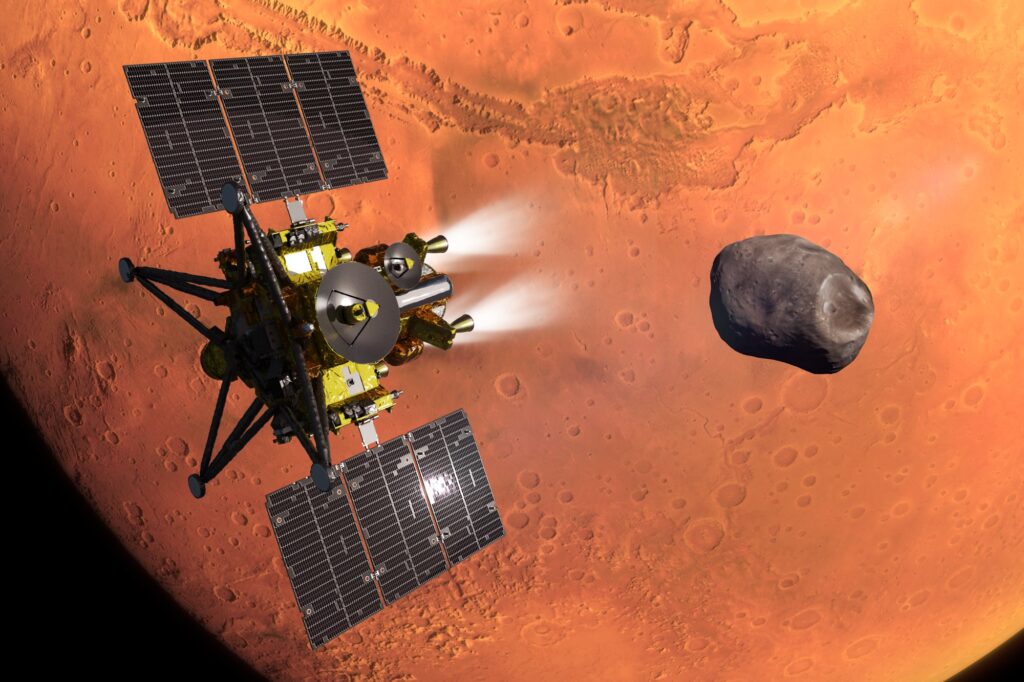
The orbiter is also the relay that Rosalind Franklin, ESA’s rover to search for past life, will depend on. CNES, the French space agency, lists the launch for the end of October 2028, with the rover to land at Oxia Planum around 2030. Those dates imply TGO will need to keep working for a further four years or more beyond this anniversary, which is why the gyroscope conservation matters. The rover is not the only Mars mission now approaching: Japan’s Phobos sample-return mission is also due to leave Earth.
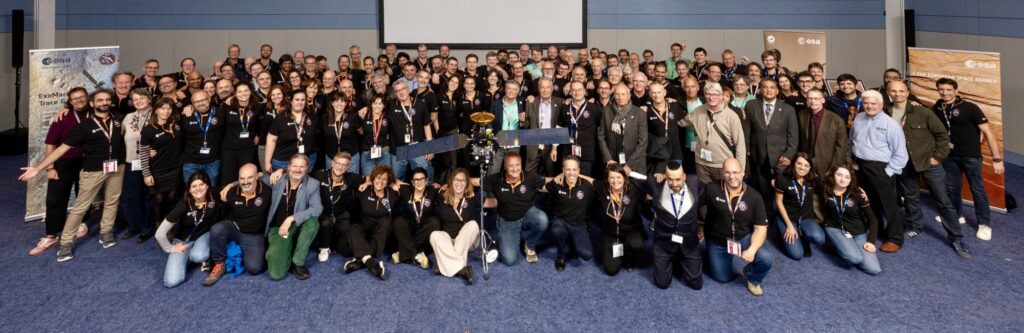
Jorge Vago, ExoMars project scientist, calls TGO “amazingly powerful” as a platform and sees its longevity as a foundation for future European planetary missions. The mission, he adds, shows a shared vision “really can be done.”