Dragonfly flew its Titan landing in software, using every sensor it will carry
On flight-like computers at Johns Hopkins APL, NASA's Dragonfly rotorcraft ran its most complete simulated first flight over Titan's dunes, from scouting a landing site to touchdown.

NASA’s Dragonfly rotorcraft has completed a simulated version of its first flight on Titan, Saturn’s largest moon, according to a NASA update. The run used flight-like avionics at the Johns Hopkins Applied Physics Laboratory (APL) in Maryland and covered most of the systems the real flight will need.
A whole landing flown on a computer testbed
In the simulation, Dragonfly separated from its protective backshell, the shell that shields it during entry into Titan’s atmosphere. It then sped over sand dunes on its own while scanning the ground for a safe place to land. Once it found one, it turned, descended and touched down. The path was drawn as a blue-green line on screen, showing the rotorcraft passing over the chosen site, circling back and starting its final descent.

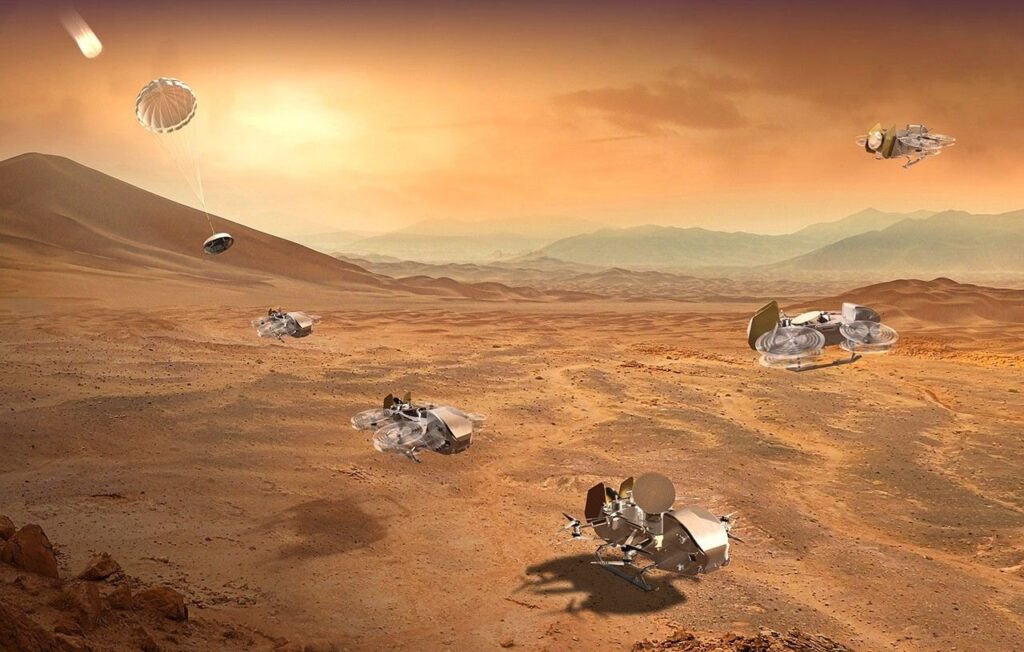
NASA calls it the most comprehensive test of the first flight so far. It ran in real time on avionics (the flight computers and electronics) that behave like the real ones, with simulated data standing in for the sensors Dragonfly will use at Titan. Those include its newly installed navigation cameras, its inertial measurement units, which track motion and orientation, and its lidar, a laser-ranging system that measures terrain height and slope and flags hazards.
No real Titan imagery was available to feed the system, so the team built synthetic terrain and generated the camera views live. Their emulator relied on graphics processors to draw every scene within the same brief exposure window, 20 to 70 milliseconds, that the flight cameras will work to. Running the whole chain on flight-like hardware showed how the pieces interact, including details measured in milliseconds as information passes between processes aboard the lander.

“The cool thing about first flight is that it’s our most challenging flight,” said Zach Putnam, Dragonfly mobility subsystem lead engineer at APL. “It uses every piece of flight sensor hardware on the lander.”
Built up one sensor at a time
The team did not start with the full sequence. It began with simulations of simple activities such as spinning a single rotor, then added a short repositioning flight and a partial scouting flight, with more sensors at each step. Lidar was the last piece. “Doing it incrementally is what enabled us to build these tests at all,” Putnam said.
Next, NASA says, the team plans to run the first flight on Dragonfly’s actual flight system rather than a testbed. Engineers will also test other flight profiles and deliberately introduce faults, to check that the rotorcraft can respond on its own if something goes wrong. That matters because Dragonfly will fly at Titan without real-time help from Earth, and Putnam said everything there “has to happen autonomously.”
Lowering the rotorcraft out of its shell
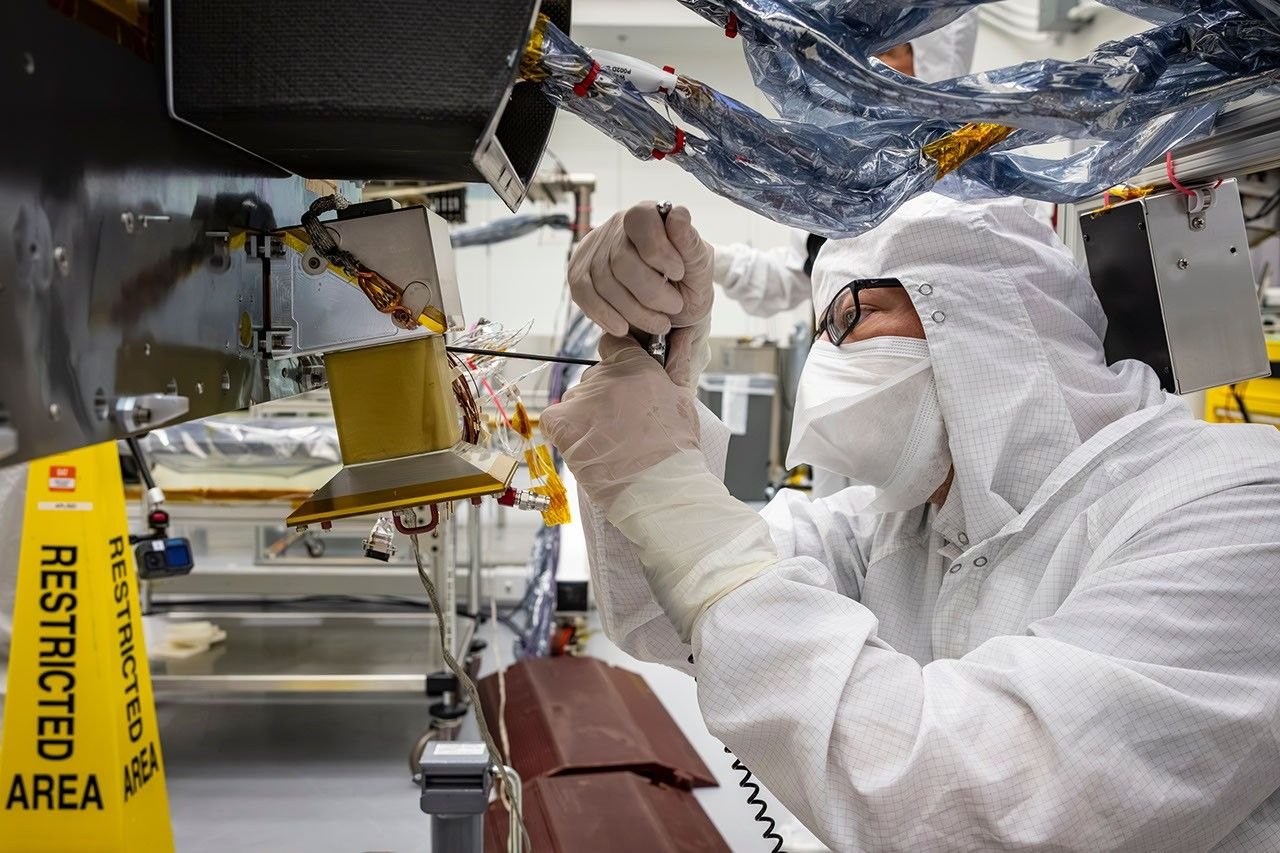
Before it can fly, Dragonfly has to be lowered into position. At Lockheed Martin in Denver, where the cruise stage and the entry, descent and landing assembly are coming together, engineers are testing the pose mechanism. During descent it will lower the rotorcraft from its stowed position inside the backshell, so the rotors can start safely before separation.
Static tests with representative mass pushed and pulled on the mechanism to check it can take the expected loads. Deployment tests measured how smoothly and quickly it lowers and whether it locks in place. Because the backshell may swing under its parachute, engineers also tilted the hardware to different angles and repeated the deployment. The pose structure connects the backshell to an aluminum interface structure attached to the lander, and that interface goes down with Dragonfly before release.
A competed mission with a long wait ahead
Dragonfly is not an open-ended project. NASA’s mission page says it was selected in 2019 as the fourth mission in the New Frontiers program, a line of medium-sized planetary missions chosen in competition, and that APL manages it. Zibi Turtle is the principal investigator.
The same page describes what the schedule buys. Launch is no earlier than July 2028, with arrival in late 2034. The mission then lasts 3.3 years, with flights of several miles each, about one every one to two Titan days. A Titan day is roughly 16 Earth days. Each flight must therefore be set up and judged largely by software, which is why the fault-injection tests matter as much as the clean run reported now.
For readers new to the target, Titan is the biggest of Saturn’s many moons; our guide to Saturn’s moons explains how it compares with the others. NASA says Dragonfly will study the chemistry, geology and atmosphere of this Earthlike moon to learn more about life’s chemical origins.