Seven superclouds near the Sun: The 2026 A&A paper and its follow-up
A catalog in Astronomy & Astrophysics describes seven elongated gas superclouds near the Sun, five of them new, and a new preprint now maps the clumps inside them.

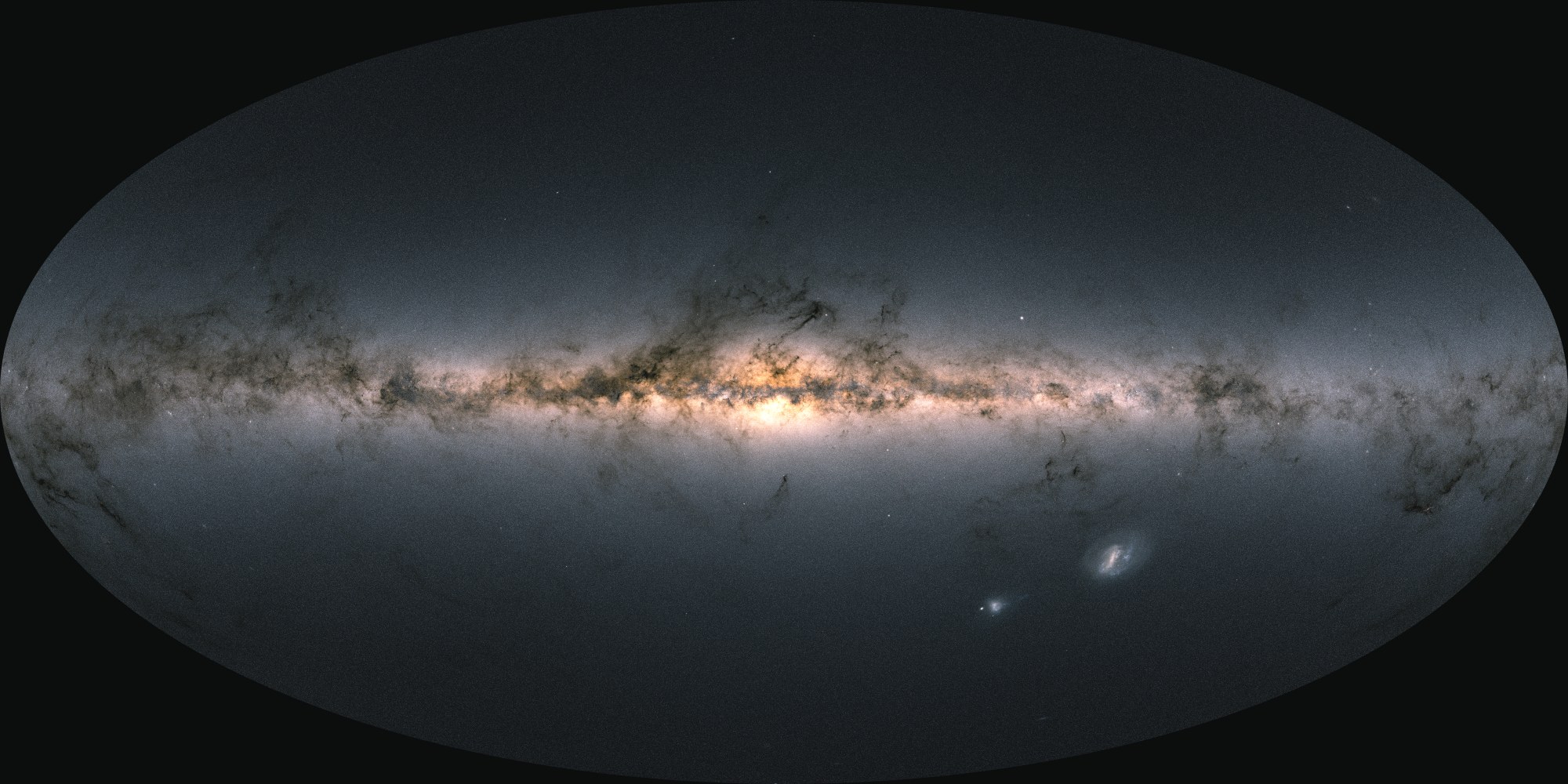
Seven long, mostly parallel gas structures lie within about 1.25 kiloparsecs (roughly 4,000 light-years) of the Sun, according to a catalog now published in Astronomy & Astrophysics. Five were previously unknown, and an August 2026 preprint from the same group maps the clumps inside them.
A catalog built from a Gaia-based dust map
The paper, “The superclouds of the local Milky Way”, is led by Lilly Kormann and João Alves of the University of Vienna. Co-authors include Michelangelo Pantaleoni González and Cameren Swiggum, also of Vienna, and Torsten Enßlin and Gordian Edenhofer of the Max Planck Institute for Astrophysics in Garching. The team received the paper on 17 July 2025 and it was accepted on 3 December 2025. The arXiv version carries the same text.

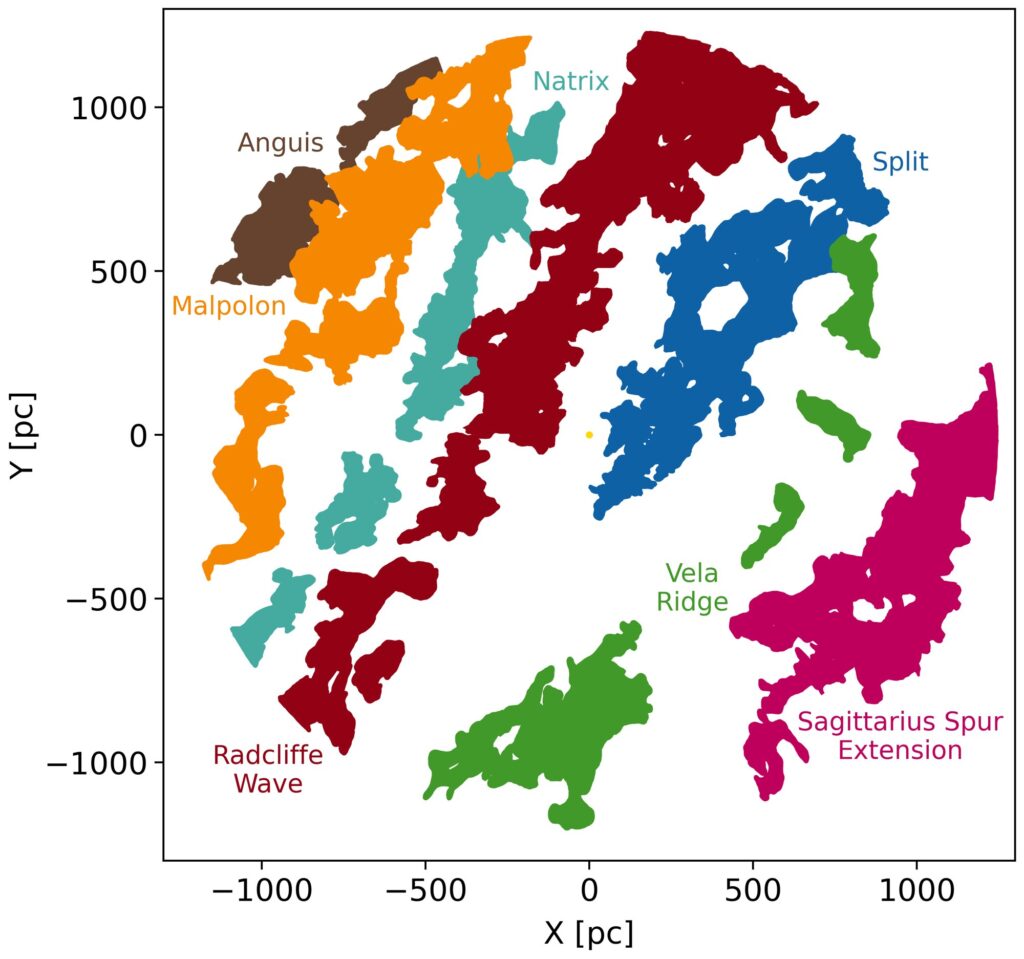
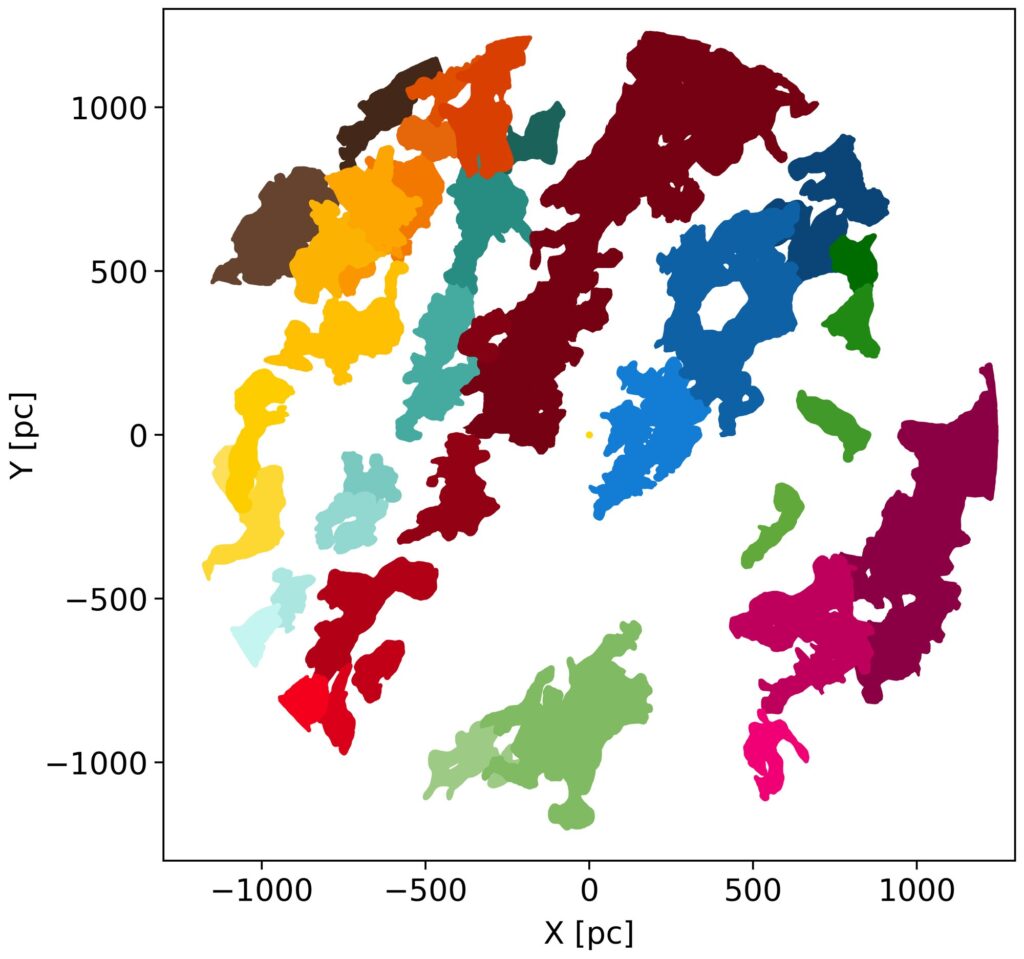
The authors started from a three-dimensional dust map of the solar neighborhood built from data from Gaia, a star-mapping space telescope. It has a resolution of 2 parsecs per voxel, a three-dimensional pixel, and reaches 1.25 kiloparsecs from the Sun. They converted the dust extinction, the dimming of starlight by dust, into hydrogen density, then used a clustering algorithm to pick out 40 individual clouds. Linking the clouds that line up in orientation and position produced seven superclouds across roughly 5 square kiloparsecs of the Galaxy.
Two of the seven were already known: the Radcliffe Wave, described in 2020, and the Split, identified in 2019. The other five are the Natrix Cloud, Malpolon Cloud, Vela Ridge Cloud, Sagittarius Spur Extension and Anguis Cloud. The paper notes that the Vela Ridge Cloud is the least coherent and may be a disrupted part of the Sagittarius Spur Extension.

Length, mass and a 56% share of the gas
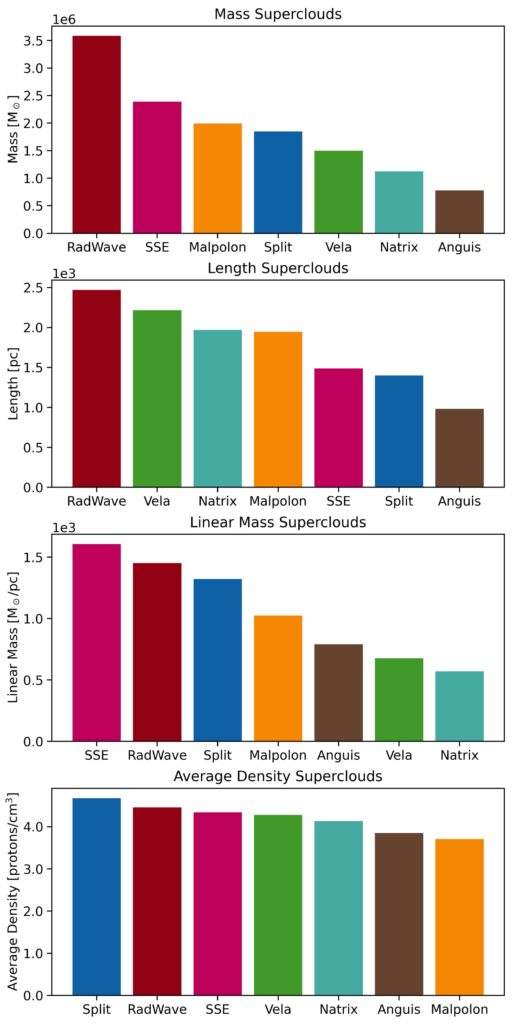
Most of the superclouds are about 1.5 to 2.5 kiloparsecs long. The exception is the Anguis Cloud, at about 980 parsecs, and it is the only one with no known star-forming region. Their masses in the paper’s table run from about 780,000 solar masses for Anguis to 3.6 million for the Radcliffe Wave. The paper’s abstract quotes a lower range of 105 to 106 solar masses, which does not match its own table. Their mean pitch angle, the tilt relative to the Galaxy’s rotation direction, is 33.5 degrees with an uncertainty of 4.0 degrees.
The superclouds hold far more gas than their size would suggest. Within 100 parsecs of the Galactic plane, they fill 9.94% of the mapped volume but hold 55.95% of its gas mass. The paper puts the total gas mass in the whole map at 3.3 times 107 solar masses. Because the map ends at 1.25 kiloparsecs, every supercloud is cut off at its edge, so the lengths and masses are lower bounds.

Which star-forming regions sit inside them
The authors report that most known nearby star-forming regions lie inside the superclouds, mainly along their central axes. They read this as evidence that superclouds feed the formation of giant molecular clouds, the denser clouds in which stars form. Science News, reporting on the preprint in August 2025, described the superclouds as possible “mothers” of those smaller clouds. This is an interpretation of where the regions sit, not a direct measurement of how the gas flows.
The study also found that the superclouds differ little in density. Their mass per unit length varies by a factor of about 4, but their volume densities differ by only about 10%. The authors interpret this as self-regulation toward pressure equilibrium with their surroundings.
Waves in six of seven, and why that is not yet explained
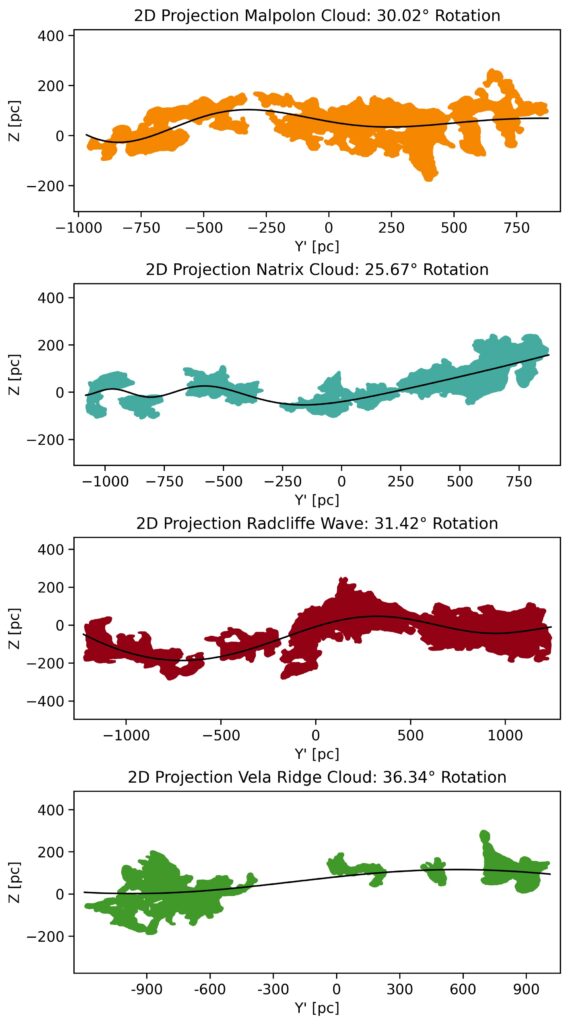
The Radcliffe Wave was first noted for its up-and-down undulation as seen from the Sun. The new catalog shows the pattern is not unique to it. Every supercloud except the Split shows an undulation in the vertical direction. The Radcliffe Wave, Natrix and Malpolon fit well to a damped sinusoid, a wave whose swings shrink along its length, and the Vela Ridge Cloud fits a simple sinusoid. The Sagittarius Spur Extension and Anguis show vertical displacement but were left out of the fitting.
The paper cautions that this fit is a simplified first description and should not be read as proof of a physical oscillation. It also states that the origin of the undulations remains uncertain. The grouping of clouds into superclouds involved judgment about orientation and alignment, and the authors say the density threshold used in the clustering has a major influence on the results. Independent astrophysicist Bruce Elmegreen, who was not involved, told Science News that the work is “just the beginning”. Alves told the same outlet the findings are “just opening a lot of doors”.
August 2026 preprint: Superclumps along the spines
A follow-up by Kormann, Alves and Emily Hunt, posted to arXiv on 21 August 2026 and submitted to Astronomy & Astrophysics, examines the interior of the seven superclouds. It has not yet been peer reviewed or published in a journal. The authors find quasi-periodic density enhancements along the spines, which they call superclumps, and say 73% of known star-forming regions in the mapped volume can be associated with them.
The spacing between superclumps is about 150 to 250 parsecs in the Split, Malpolon Cloud and Vela Ridge Cloud, and about 250 to 380 parsecs in the Radcliffe Wave, Natrix Cloud and Sagittarius Spur Extension. That is two to three times smaller than the roughly 560 parsecs expected for an isolated, self-gravitating cylinder. The authors interpret the difference as fragmentation under external pressure. They conclude that giant molecular cloud formation is shaped by the large-scale fragmentation of the parent superclouds, not only by local, random processes. If the preprint holds up in review, it would place the superclumps as an intermediate scale between the kiloparsec-long gas lanes and the 10 to 100 parsec giant molecular clouds.