NASA Jupiter photos: The best Juno images and what they reveal about the giant planet
NASA's Juno spacecraft has photographed Jupiter from closer than any camera before it, and its images show deep storms, polar cyclones and a volcanic moon.

Dates and facts checked on the official pages on October 25, 2026.
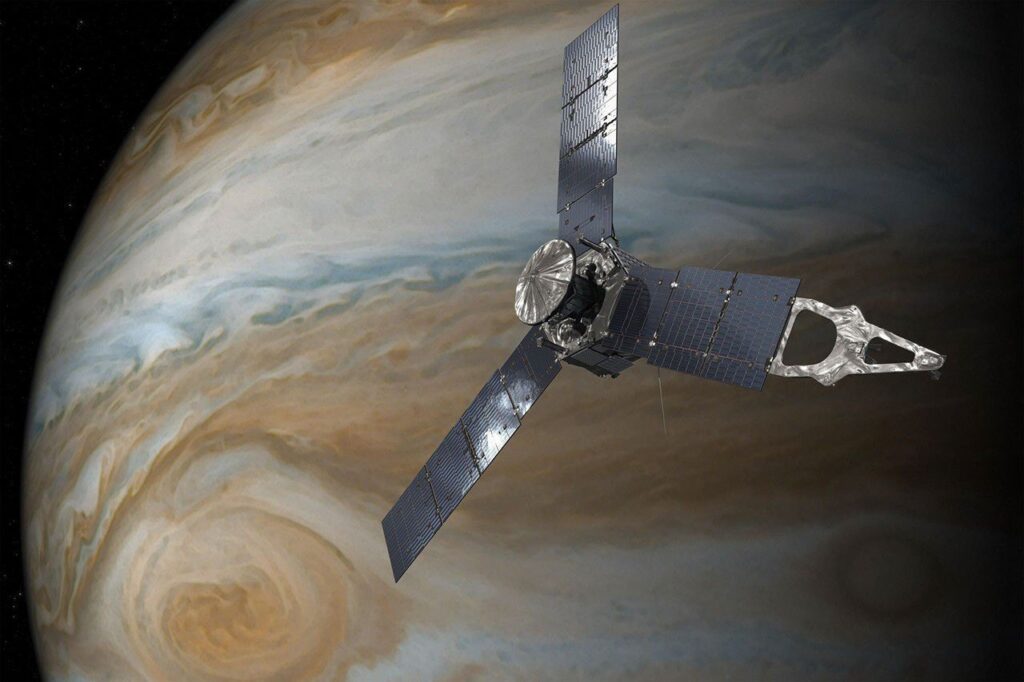
The best NASA photos of Jupiter come from Juno, a spacecraft that has orbited the planet since July 4, 2016, and carries a visible-light color camera called JunoCam. Its pictures show the Great Red Spot, cyclones clustered at both poles, lightning glowing in the clouds and the shadows of moons, all from far closer than Earth-based telescopes can manage.
These are not only pretty pictures. Each famous Juno image links to a measurement of what lies below the clouds, and the sections below pair the two.

Where to find the official Juno photos and who processes them
NASA publishes Juno pictures on its Juno mission page at science.nasa.gov and in its image library at images.nasa.gov, where each one has an identifier beginning with PIA. JunoCam was included, according to NASA, to engage the public, so its raw frames are released for anyone to download.
That is why many of the most striking images credit a second name. Citizen scientists such as Kevin M. Gill, Gerald Eichstädt and others turn the raw frames into finished pictures, adjusting color and contrast. NASA’s credit lines read, for example, “NASA/JPL-Caltech/SwRI/MSSS; processed by Kevin M. Gill.” The enhancements are an interpretation of the data, so the colors in many views are stronger than a human eye would see.

| Image | NASA ID | Processed by |
|---|---|---|
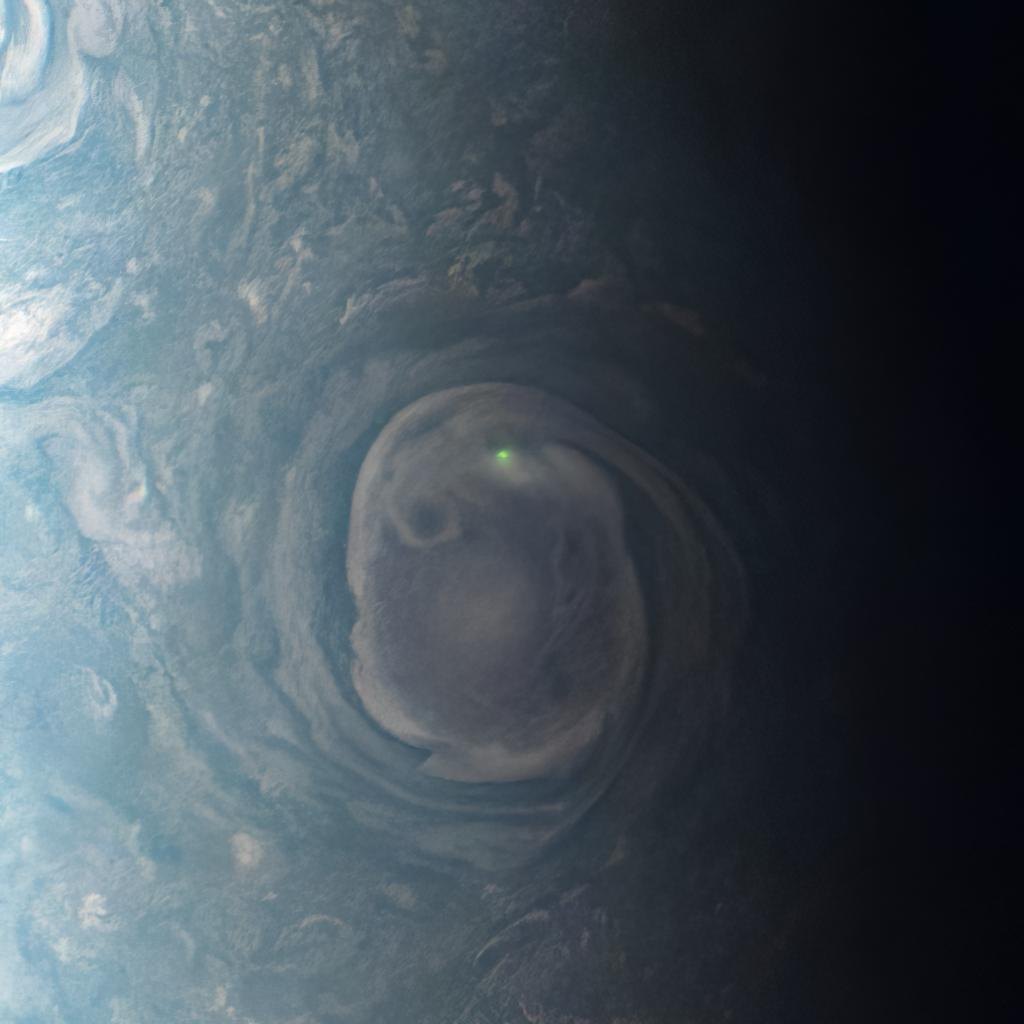
| Lightning glow near the north pole | PIA25020 | Kevin M. Gill |
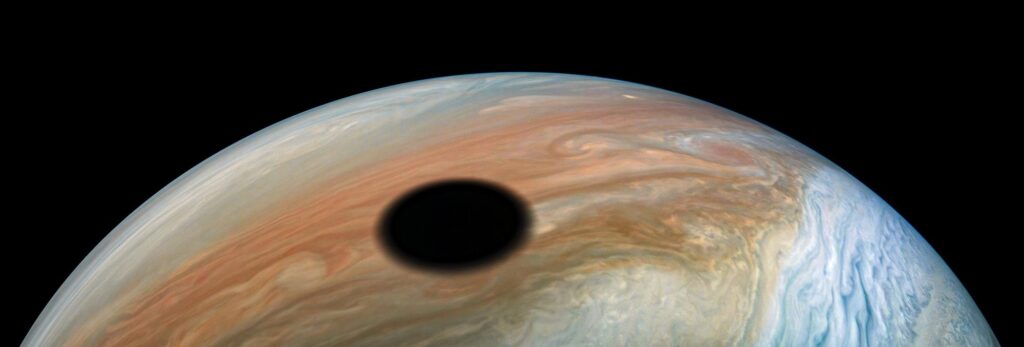
| Io casting its shadow on Jupiter | PIA23437 | Kevin M. Gill (enhanced) |
| Jet N3 region of the cloud belts | PIA23439 | Gerald Eichstädt (enhanced) |
| Ganymede close-up | PIA24681 | NASA/JPL-Caltech/SwRI/MSSS |
| Europa stylized view | PIA25335 | Fernando Garcia Navarro, based on work by Kevin M. Gill |
Identifiers and credits checked on NASA’s Juno mission page on October 25, 2026.
The Great Red Spot is a storm about twice as wide as Earth
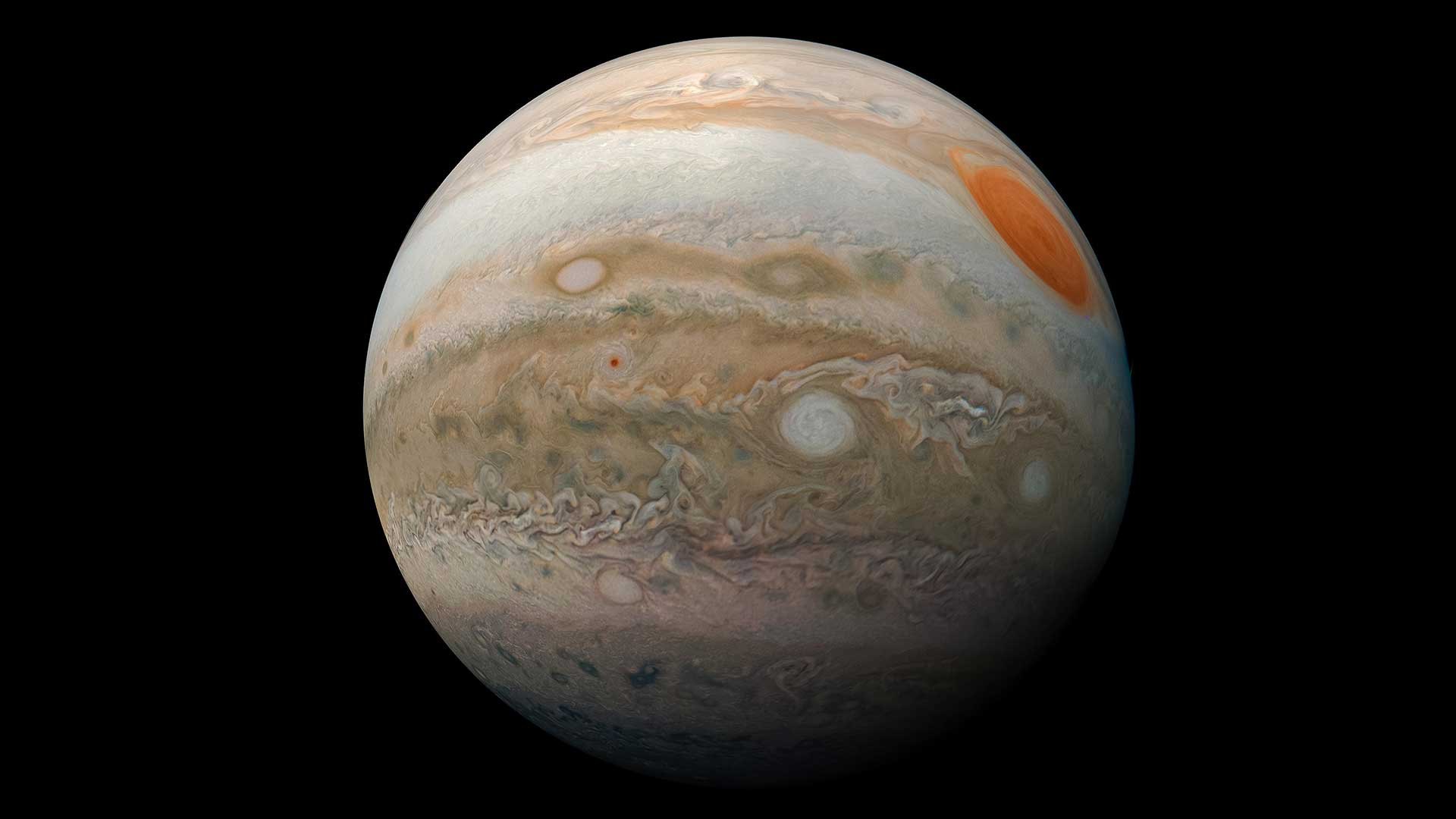
The Great Red Spot is Jupiter’s best-known feature: an enormous storm that, according to NASA, has been observed for more than 300 years and is about twice as wide as Earth. Juno imaged it on February 12, 2019, and the resulting view is among the most reproduced pictures of the planet.

The pictures show the surface of a storm; Juno’s other instruments measured its depth. NASA reports that the spot’s roots reach about 200 miles (320 km) deep, and that the storm appears to be shrinking. Because Jupiter is made mostly of hydrogen and helium with no solid surface, a storm there is bounded only by the layers of gas around it, so depth is a basic question about what such a storm is.
The belts and zones run about 1,900 miles below the cloud tops
Jupiter’s striped look comes from alternating bands of cloud: darker belts and lighter zones. Each band is a jet stream, a fast current of wind flowing in one direction. Close-up images such as the Jet N3 region view show how turbulent the edges between bands are, with swirls and white ovals along each boundary.

Juno’s measurements showed that this is not a thin skin of weather. NASA says the belts and zones extend about 1,900 miles (3,000 km) below the cloud tops. The visible clouds themselves are layered, according to NASA: ammonia ice on top, ammonium hydrosulfide in the middle, and water ice and vapor at the bottom. For the planet’s size and place among the others, see the guide to the planets in our solar system in order.
Cyclones in patterns crown both poles
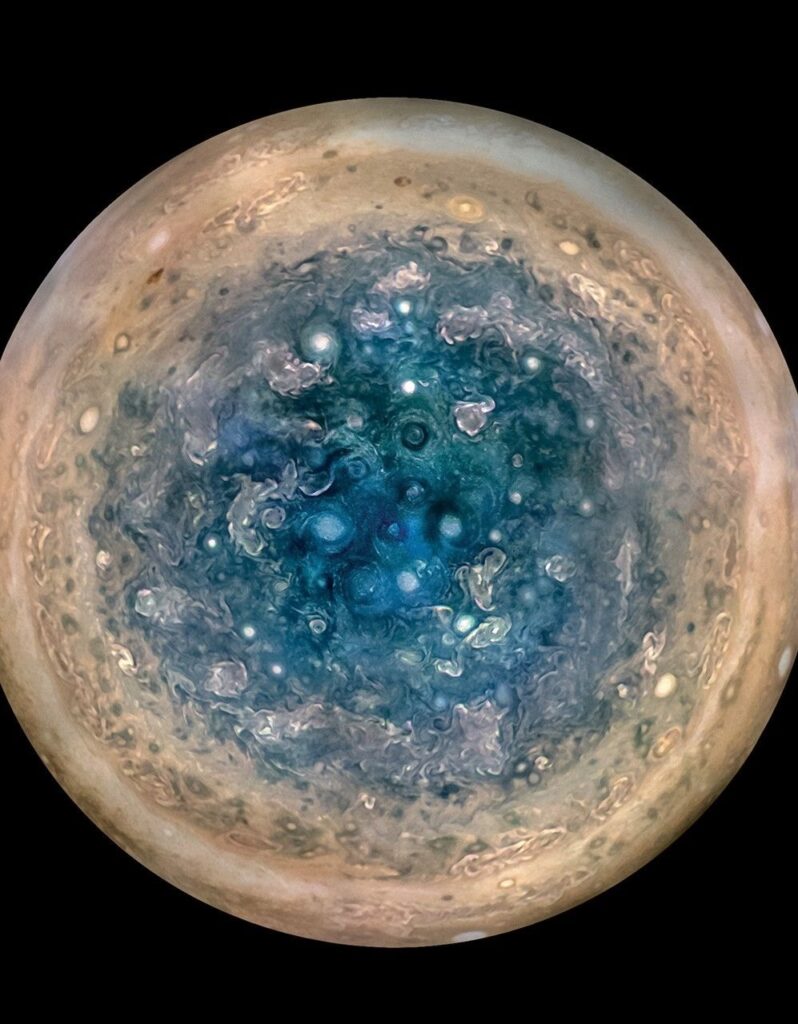
Earlier spacecraft saw Jupiter mostly from near its equator. Juno flies over the poles, and its pictures of the south pole show a ring of cyclones arranged in a pattern. NASA reports that similar patterns sit at both poles, and that the storms at the north pole do not merge with each other.
Why the cyclones stay separate, instead of combining into one large vortex, is still a question that these polar images help researchers test. This is a different weather system from the equatorial bands: it sits in a region no earlier camera had viewed this closely.
Lightning glows in the clouds far from the equator
One image, catalogued as PIA25020, shows a lightning glow near Jupiter’s north pole. Lightning is a flash of electricity inside clouds, and on Earth it is common in the tropics. Seeing it near the poles of Jupiter is notable because it shows that the planet’s weather carries energy to high latitudes.
The scene was captured by JunoCam in visible light, with the glow on the night side of the planet appearing against the dark clouds. The processed frame is credited to NASA/JPL-Caltech/SwRI/MSSS and Kevin M. Gill.
What the images cannot show: A fuzzy core and a huge magnetic field
Some of Juno’s biggest results come not from the camera but from its gravity and magnetic instruments. NASA says Jupiter’s core is larger than expected and appears partially dissolved into the layers above it, so researchers call it a “fuzzy” or dilute core. During its 35 prime-mission orbits, Juno collected more than three terabits of science data, according to JPL.
The magnetic field is also stronger than predicted. NASA puts it at roughly 16 to 54 times as strong as Earth’s, and attributes it to electrically conducting liquid metallic hydrogen deep inside acting as a dynamo, a moving, electrified fluid that generates a magnetic field. Juno also found the Blue Spot, an invisible magnetic feature near the equator that appears to drift eastward.
Io, Ganymede and Europa: The moons Juno photographed after its prime mission
After the prime mission, Juno’s extended mission widened its scope to the whole Jovian system, including the rings and the moons. Jupiter has 115 officially recognized moons, according to NASA, and the four largest are Io, Europa, Ganymede and Callisto; the guide to which planets have the most moons compares Jupiter with Saturn.
NASA describes Io as the most volcanically active body in the solar system. Its surface carries hundreds of volcanoes, the tallest lava fountains rise tens of miles above the ground, and some vents feed broad pools of molten rock. Juno flew close past Io in December 2023 and February 2024, and NASA reports fresh lava fields as a result. In the image of Io casting its shadow on Jupiter, the small dark spot on the cloud tops is the moon’s shadow, a view like a solar eclipse seen from Jupiter. Ganymede and Europa also have Juno close-ups, and a stylized Europa view is among the library images.
Juno also helps with the planet’s faint rings. NASA says Voyager 1 discovered them in 1979, that they are made of small dark particles, and that they are hard to see except when backlit by the Sun. For how they compare with the other planets’ rings, see which planets have rings.
Juno’s mission was scheduled to end in September 2025
NASA’s Juno page says the extended mission was scheduled to end in September 2025, after which the spacecraft’s orbit would degrade and Jupiter’s gravity would pull it into the atmosphere. NASA’s page still labels the mission “active,” and the JPL mission page lists it as current, but neither confirms the spacecraft’s operating status after that date. Readers should check the Juno page at science.nasa.gov for the latest word.
Whatever the spacecraft’s status, the archive remains open. Juno’s raw frames and processed images stay available to download, and new processed versions can still appear from the citizen scientists who work with them.
Common questions
Where can I find NASA pictures and images of Jupiter?
NASA’s Juno mission page and the image library at images.nasa.gov hold the official Juno pictures, each with a PIA identifier and a credit line. Search the library for “Juno” or for a specific ID such as PIA25020. Raw JunoCam frames are also released for public processing.
How wide is Jupiter, and how far is it from the Sun?
According to NASA, Jupiter’s radius is 43,440.7 miles (69,911 km), which makes it about 11 times wider than Earth. It orbits at an average of about 484 million miles (778 million km) from the Sun, or 5.2 astronomical units, a unit equal to the average Earth-Sun distance. Sunlight takes roughly 43 minutes to reach it.
How long is a day on Jupiter?
About 9.9 hours, the shortest day of any planet in the solar system, according to NASA. A year there is far longer: about 12 Earth years, or 4,333 Earth days.
Are the colors in Juno’s pictures real?
The underlying data is from a visible-light camera, but many published images are processed by citizen scientists, who adjust color and contrast to bring out detail. NASA’s credit lines say when an image is enhanced.
Figures checked on NASA’s Jupiter facts page on October 25, 2026.